
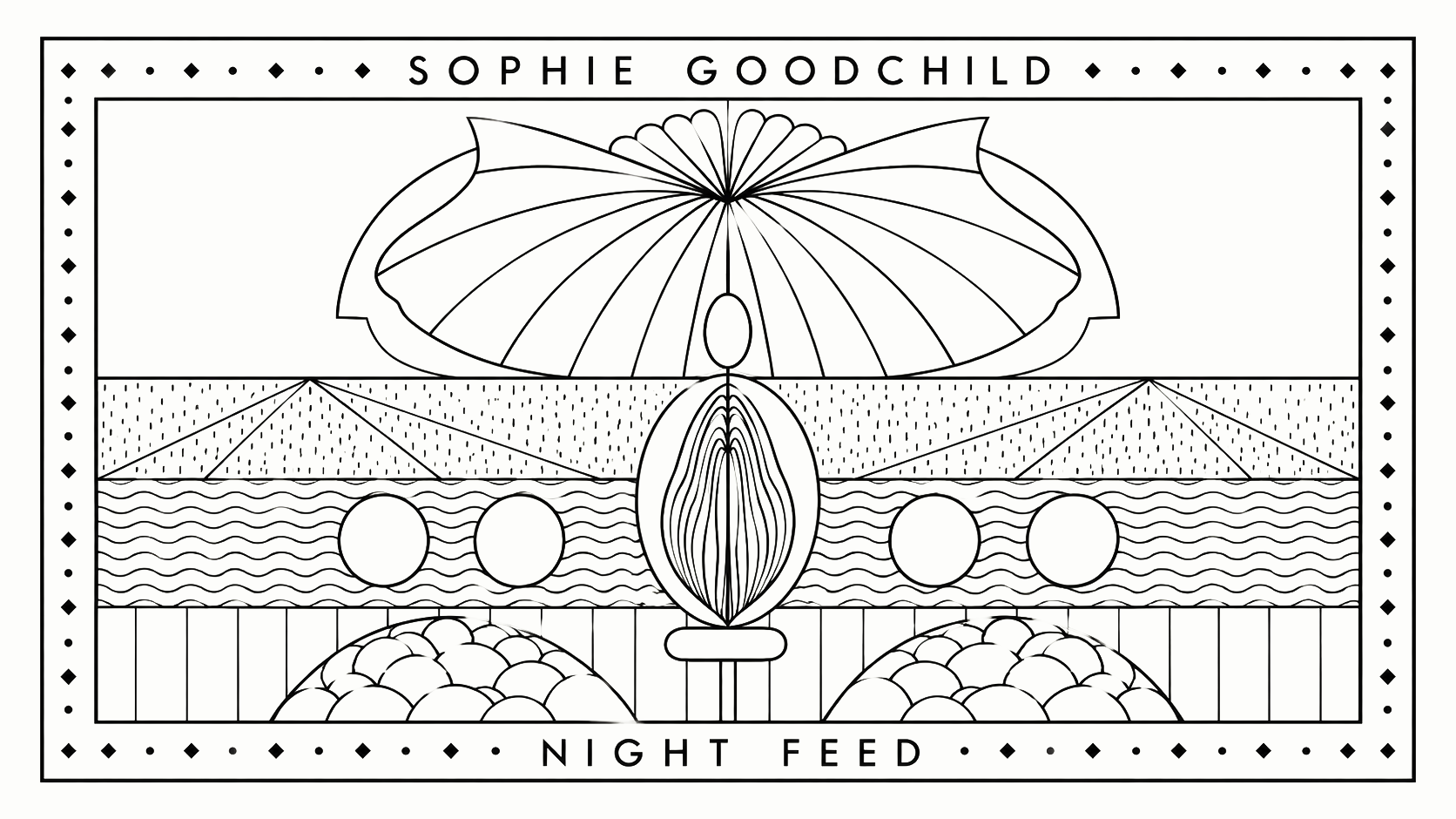
Sophie Goodchild: Night Feed
Sophie Goodchild’s Night Feed brings together a new body of felted works developed during her residency at Porthmeor Studios in St Ives, Cornwall. Based in Nottinghamshire, Goodchild worked from Studio 5 with the Atlantic directly behind her: audible through the walls, visible from the studio and encountered through swimming, walking and repeated attention to the coastline.
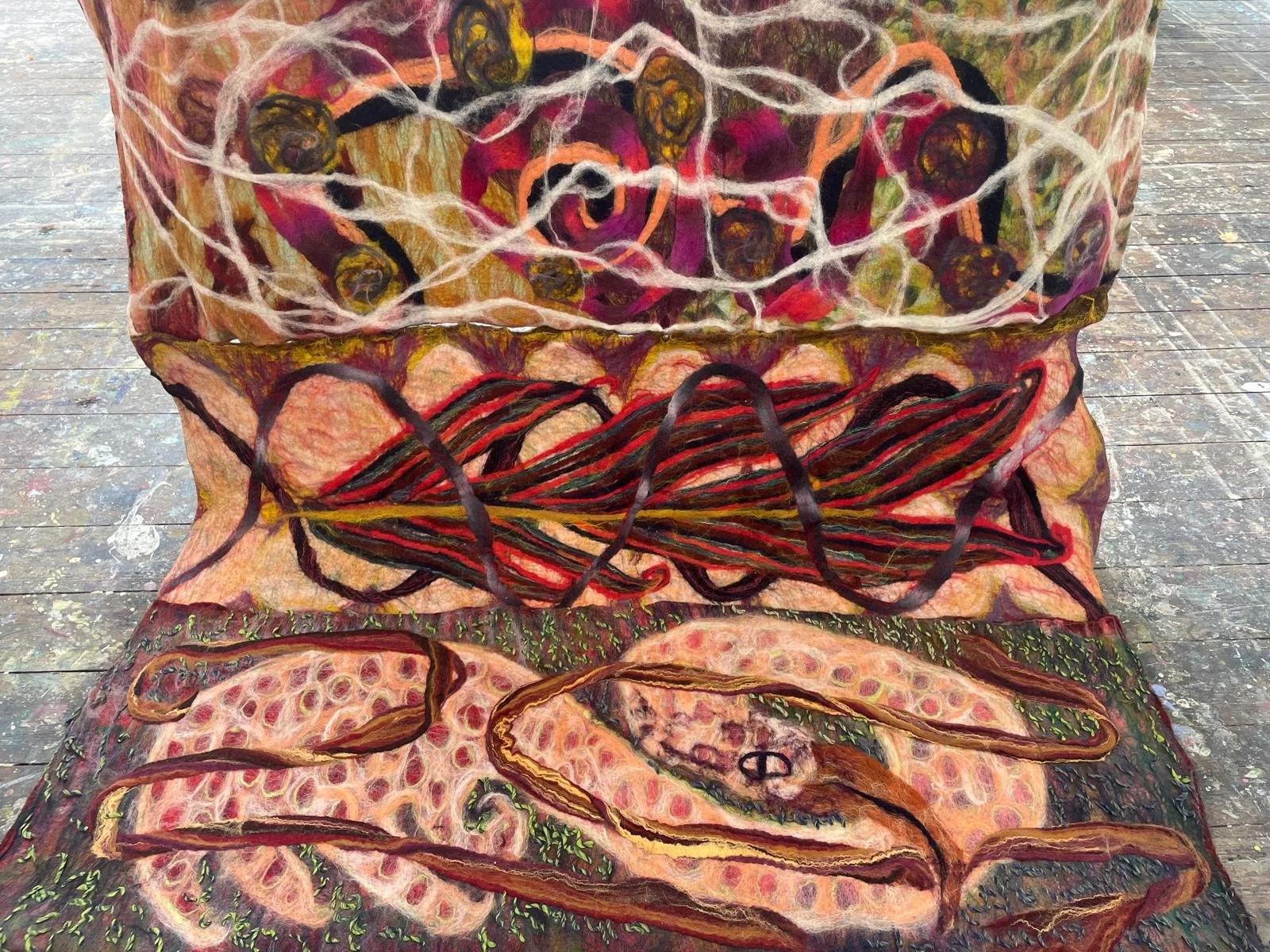
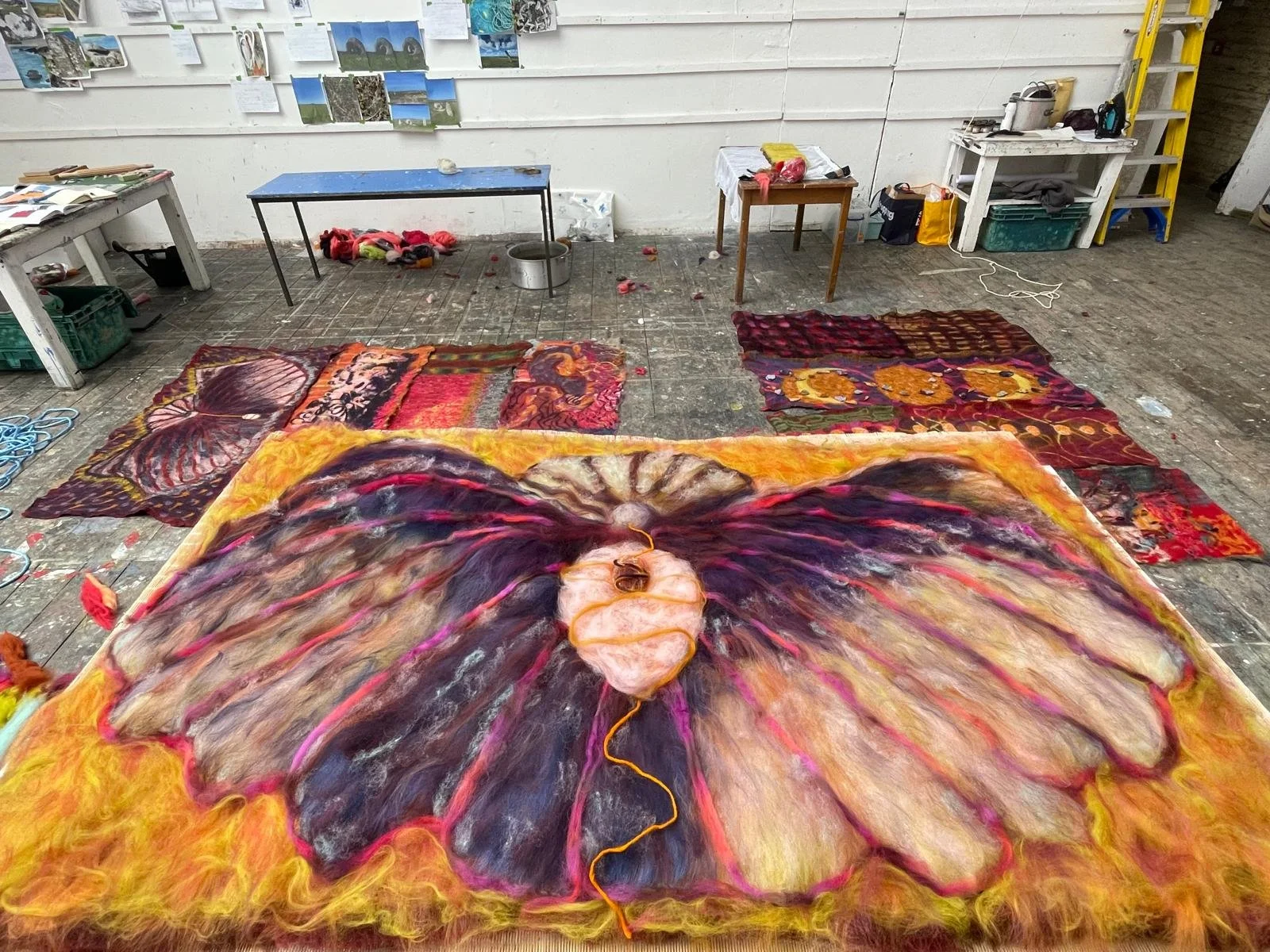
The works developed during the pregnancy of Goodchild’s second child, bringing an intimate experience of bodily change into an established practice concerned with material transformation, containment, layering and geological time. At high tide, Studio 5 became almost womb-like, filled with the heavy swell and pulse of the sea. The physical environment became a framework through which Goodchild considered the relationship between body and landscape. The studio’s panelled structure is reflected in the panoramic scale of the new works, while the layered strata and fissures of the granite landscape provided a vocabulary for the construction of the felt panels.
Goodchild describes pregnancy as something that altered her perception of scale and presence: “I find myself forgetting sometimes that this baby is growing and is everywhere with me all the time. Bobbing in the expanse of the sea in its own small, contained, protective sac of water.” The distinction between containment and confinement runs throughout the work. Wool and water provide a responsive material language through which to explore this tension. Loose fibres are saturated, compressed and worked until they become dense, coherent surfaces. Water is both an agent of transformation and something that must be controlled. Rather than applying an image to a surface, Goodchild gradually produces the surface itself through fibre, pressure, moisture and repetition.
At Porthmeor, this process became closely connected to the geology of West Penwith. Walking the coastal paths, Goodchild considered rock formations and layered strata as physical structures within which to make. Granite fissures suggest folds in skin; linear markings recall geological divisions as well as the changing surface of the pregnant body. Her use of the “linear, or nonlinear line” allows imagery to split, connect and accumulate within the unpredictable fibres of wool, soap and water.
Her research also extended into histories of transformation, drawing on alchemy and symbolic forms of generation. Images and ideas including Piero della Francesca’s Brera Altarpiece, historical diagrams of pregnancy, the cosmic egg, the seed of life and the myth of Leda entered her research. Eggs, vessels, shells, caverns and openings recur as forms capable of holding something unseen: life, energy and the potential for transformation. Early morning walks around West Penwith revealed dew-filled funnel webs around the stone circles, their delicate surfaces creating an illusion of depth and passage. Goodchild’s observation that “everything is hole-y” captures the strange relationship between absence and abundance within the work.
Below the studios, fishermen prepared their nets, their repetitive work providing an unexpected parallel to Goodchild’s own process of making. The slow preparation of the nets before casting echoed the gradual layering of wool before it is transformed through water, pressure and repeated movement.
In Night Feed, these cycles continue through the rhythms of tide, pregnancy, labour, feeding and making. The title suggests an intimate act of care, but also a repetition governed by the body rather than the clock. The works occupy an unstable space between painting and textile, image and object, abstraction and embodied experience. They are neither representations of the landscape nor illustrations of the body, but emerge through a process in which the two continually overlap.
These notes, made during the development of the work, perhaps offer the most direct entry into its particular energy. Night Feed brings together the expansive and the intimate, the ancient and the immediate, the monumental and the bodily. Its surfaces hold the physical memory of water, wool, landscape and labour.
Sophie Goodchild is a Nottingham-based artist whose work has been exhibited across the UK, including at Flowers Gallery, Saatchi Gallery, Standpoint Gallery, Sid Motion Gallery and Trafalgar Avenue. She has held solo exhibitions at Flatland Projects, Bexhill and Trafalgar Avenue, London, and undertaken residencies and placements including AA2A at Loughborough University, Troy Town Art Pottery Residency and a Graduate Studio Award at Backlit Gallery, Nottingham. She holds an MA in Painting from the Royal College of Art and a BA in Fine Art from Kingston School of Art.